"Sado Island Gold Mine" World Cultural Heritage Registration Promotion Project


Yamamoto Richard Toma, who holds the highest level of "Meister" qualification in the World Heritage Examination, visited Sado City for three days in mid-October. He inspected the Aikawa Gold and Silver Mine, Tsurushi Silver Mine, and Nishimikawa Gold Mine, which make up the World Heritage Site "Sado Island Gold Mines." From his perspective as a Meister, he explored the value of the heritage and ways to preserve and utilize it. We present a report on his visit.


Yamamoto Richard Touma
Born in Lyon, France in 2005. Originally from Kyoto Prefecture. At the age of 11, he became the youngest person at the time to obtain the highest level of "Meister" in the World Heritage Examination. He is active as a contestant and mystery hunter on "Hitachi World Mysteries Discovered!" (TBS), and as the "World Heritage Doctor-chan" on "Sandwichman & Mana Ashida's Doctor-chan" (TV Asahi). He is currently studying at the Faculty of Law, Faculty of Letters, University of Tokyo. He is also a World Heritage Academy certified lecturer, widely communicating the importance and universality of World Heritage. His books include "WOW Factor: A Fortress of Peace in Your Heart" (Shogakukan).


Unique handicrafts have developed, and the atmosphere of a mining town still remains today
Kirarium Sado
The tour of Sado began at Kirarium Sado. Yamamoto first learned about the history, characteristics, and changes of the Aikawa Tsurushi Gold and Silver Mine (Aikawa Gold and Silver Mine, Tsurushi Silver Mine) and Nishimikawa Gold Sand Mine, which make up the World Heritage Site "Sado Island Gold Mines," through exhibits of video materials and replicas of picture scrolls.
Our guide, Kimiko Ishikawa of the Sado City World Heritage Division, explained, "During the Edo period, when Japan was closed to the outside world, not much foreign technology was introduced, but Sado produced large amounts of gold through advanced handicrafts." She cited the fact that the sites where gold and silver were produced remain as ruins, and that well-preserved documents still exist, proving that advanced technology was used, as reasons for registering the island as a World Heritage Site, and emphasized, "Sado Island's gold mines can fill in the gaps in the history of gold in the world."
"When gold was discovered, people flocked to Aikawa from all over the country, and it became a mining town with a population of 50,000. The population density was high, and many temples were built," said Ishikawa. As Yamamoto listened to the explanation, he also thought about the daily lives of people at the time, outside of mining work.
At Kirarium, we also tried our hand at the popular tourist activity of "making oval coins." We showed our attention to detail by carving horizontal lines into the mat, creating an original, one-of-a-kind oval coin.


Daijiriyama Mine
Led by guide Hisaya Hamabe (Golden Sado), Yamamoto stepped into the Taiseiyama Mine.
The Taiseiyama Mine was opened by prospector Mikata Yojiemon in 1634, and it is said that it took him 14 years to reach the gold vein 400 meters away. To prevent oxygen deficiency inside the mine, two tunnels were excavated in parallel, with a tunnel passing through them midway to ensure fresh air. Mining continued from the Meiji period through to the Showa period.
Hamabe explained the difference between the "hand-digging" of the Edo period and the "mechanical digging" of the Meiji period, which was widened to allow for the passage of trolleys. "The tunnels of the Edo period, dug only with chisels and hammers, have a smooth finish, but those dug by machine end up being bumpy," he said.
Pointing to the wall separating the two tunnels, Hamabe said, "The bedrock is extremely hard, so even though it's this thin, it won't collapse. The reinforcement measures to prevent collapses that are common in other mines aren't even used here. It was so hard that in the Edo period, it was said that work progressed well if you could dig one meter a day."
Along the way, Yamamoto saw the "hole" that connects the two tunnels and allows air to circulate, and the space where gold ore is temporarily stored and loaded onto trolleys, and was amazed at the precision of the manual work of the time, which is comparable to the mechanized work of the Meiji period and later, and the uniquely smooth surface of the tunnels.


Historic Site: Sado Gold Mine
Yamamoto visited the historic Sado Gold Mine, which is crowded with tourists, and took two courses: the Sotayu Mine from the Edo period, and the Doyu Mine, whose remains remain from the Meiji period onwards.
At the Sotafu Pit, our guide, Mr. Ishikawa, explained, "About 90 years after the mine opened, the tunnels reached below sea level, and the battle with water began." He explained about the "mizu-kaesoku" (water-repairing laborers) who used "suishorin" (water wheels) to pump water up to the surface, saying, "Initially, the second and third sons of farmers worked there, but when there weren't enough, they brought in homeless people (without family registers) from Edo."
As you go further into the mine tunnels, you will come across a "tanuki-ana" (raccoon dog hole) that was dug while searching for ore veins, a "wind-sending horiko" doll that sends air for ventilation, and a re-enactment of the "yawaragi" ritual, a prayer for the prosperity of the mine. Ishikawa explained, "The air became polluted by the fires from torches and vegetable oil, so a device to send air was needed," and "Because the mountain god is a woman, women cannot take part in yawaragi."
Continuing on, Yamamoto went to the Doyu Mine, where he went right below the V-shaped excavated "Doyu no Warito." Ishikawa said, "When I spoke to workers and their families at the gold mine (which operated until 1989), they told me things like, 'We are proud to have lived alongside the mine,' and 'We have survived because our fathers worked and risked their lives.'" Yamamoto nodded in agreement, saying, "It is important to pass on valuable stories about the mine that don't just look at one side of the story."


Kyomachi Street
After leaving the Historic Site of Sado Gold Mine, Yamamoto visited the Aikawa Kamimachi district, which once flourished as a mining town. The old townscape still remains, and the main street that once connected the gold mine with the Sado Magistrate's Office is now widely known as Kyomachi Street.
As Yamamoto walked with guide Ishikawa, one thing that caught his eye was a traditional townhouse. In order to make effective use of the small amount of land, some of the houses even share a single wall with neighboring houses. According to Ishikawa, "As the mine downsized, the company housing was sold off and turned into homes for local residents." The tiled roof also bears the crest of Mitsubishi, the company that operated the Historic Sado Gold Mine. The former mine manager's residence has been renovated and is now used as a cinema cafe.
Halfway up the slope, an ivy-covered concrete wall came into view. This is the former Aikawa Detention Branch, which opened in 1954 and was in use until 1972. A rare wooden detention center still standing is registered as a national tangible cultural property. "Suspects of traffic violations and election fraud were detained here," said Ishikawa. Upon hearing that "it's now used for jazz concerts and film shoots," Yamamoto looked up at the high ceiling and commented, "The acoustics must be great," showing interest in the practical use of a cultural property.
Sado Magistrate's Office Site
After strolling down Kyomachi Street, Yamamoto visited the site of the former Sado Magistrate's Office. This late Edo-period government office was destroyed by fire in 1942 (Showa 17) and was restored in 2001. In addition to administrative and judicial facilities, the site also houses ore-dressing and smelting facilities, suggesting that the magistrate's office at the time played an important role in Sado's gold and silver production.
Our guide, Mr. Ishikawa, pointed out that 172 lead plates used in the cupellation method of refining gold were discovered underground on the site, and explained, "Lead is hardly available in Sado, so they were brought from Murakami (in the north of the prefecture)."
Meanwhile, Yamamoto-san was impressed as he looked at picture scrolls that still tell the story of the post towns along the "Okina Road," the road that transported gold from Sado to Edo, saying, "I guess the fact that the documents have been preserved so well was appreciated."
Next, Yamamoto visited the "Seriba" (finishing field) where the ore-dressing process was carried out. He was given an explanation of the "yakikin" method, which uses salt to separate gold and silver, as well as about the artifacts unearthed during the excavation, such as mortars and ceramics.
From mining to ore dressing, smelting, and the production of oval coins at the Goto Office (Mint Bureau) adjacent to the Magistrate's Office, the tour on the first day deepened our understanding of the uniqueness of Sado, where the entire production process is carried out consistently on the island.


[Looking back on Day 1]
It was a very valuable experience to have the opportunity to see inside the mine tunnels, which are essential for extracting gold and silver. I was particularly surprised by the hand-digging techniques used in the Edo period at the Daijiroyama Mine. There was no difference compared to the machine-mined mines.
At the Sado Gold Mine, in addition to the gold mining carpenters who extracted the ore and the horiko who assisted in the work, the exhibition also featured homeless people. The exhibits dealing with mining labor in the Edo period reflected the situation at the time and were very easy for visitors to understand.
During the period when Japan was closed off to the outside world, mechanization advanced in the Potosi silver mine in Bolivia and various gold mines in Europe. However, in Sado, high-quality gold was extracted efficiently by hand, and the mines developed in a unique way. This is what makes the Sado Island gold mine so appealing, and why it has been recognized as a World Heritage Site.
Nomination documents for the World Heritage Site often compare Sado with other heritage sites. In Europe, there are villages where people go to work in distant mines, but Sado can be described as a "mining village" where mining work is integrated into the village structure. Cultures such as Noh and pottery were absorbed into the village, and the islanders have developed in their own unique way thanks to their active involvement.
The author Shiba Ryotaro wrote about Sado, with the American mining towns that were destined to fall into disuse after the Gold Rush in mind, saying, "The town itself remains dignified... it has survived." This was my first time visiting Sado, and I was deeply moved by the steady cycle of agriculture, forestry, and fisheries, and the continued inheritance of cultural traditions, that this is truly the kind of society it is.


Mining with advanced technology,
Traces of the past in the mountains
Tsurushi Silver Mine
Tsurushi Silver Mine is the largest silver mine in Sado, discovered in 1542 (Tenbun 11) during the Sengoku period. Although the weather on the second day was unfortunate with heavy rain, we were able to tour the remains of the magistrate's residence (jin'ya) built by Uesugi Kagekatsu to manage and operate the silver mine, the Tsurushi Aramachi ruins where the miners lived, and Otakimabo, one of the most famous mine tunnels.
Atsuo Wakabayashi of the Sado City World Heritage Division, who served as our guide, explained, "At Tsurushi, we followed three stages of technological change: 'outcrop digging,' which removes ore visible on the surface; 'hioi-bori,' which digs into the silver vein; and 'shaft digging,' which cuts across the vein and digs a horizontal tunnel."
We headed to the site of the magistrate's residence, admiring the remains of the dry moat, a remnant of a mountain castle from the Warring States period. Wakabayashi explained, "Investigations have detected elements of lead and silver used in smelting, so there is no doubt that the cupellation method was practiced here." He also explained that at the Tsurushi Aramachi ruins, flat "terraces" were constructed on the steeply sloping terrain to ensure living space.
Yamamoto walked along the mountain path and arrived at Otakimabu, where there is an entrance to the waterfall basin. Researchers from Shimane Prefecture used a robot to examine the inside, and said, "The inside was just as described in old maps."


Nishimikawa Gold Mine
Yamamoto next visited Nishimikawa Gold Mine in southwestern Sado. It is the oldest gold mine on Sado, and is even mentioned in the Heian period "Konjaku Monogatarishu." The mine was mined using a technique called "o-nagashi," which involved digging up the mountain and using the power of water to wash away excess soil and sand in one go, allowing the gold dust that had sunk to the bottom to be collected.
With Wakabayashi as his guide, Yamamoto set foot on Mt. Goshaya, where mining once took place. As Wakabayashi said, "There has been no development since then, so the situation from back then remains to this day," and in places you can see the rubble left over from the collapse of the mountain, as well as traces of stone-built channels that took advantage of the slope to channel water.
"Reservoirs were created using different water sources for each mountain. Surveying techniques were established, including meticulous calculations of the amount of water and the flow," said Wakabayashi. Yamamoto's imagination was running wild as he recalled the video of the "O-Nagashi" (a type of river flowing through the water) that he had watched at Kirarium Sado the previous day.
Nishimikawa Gold Mine's production gradually declined from the mid-Edo period onwards, and the mine closed in 1872 (Meiji 5). However, the people who had been working to mine the gold remained in Sasagawa village, making a living through charcoal burning and farming. The village still retains the Kaneko Kanzaburo family, who served as village head for generations, and Oyamazumi Shrine, which was built in prayer for the prosperity of the gold mine, and these remain today, conveying the village's former prosperity. In 2011, the area became the first in the prefecture to be designated as a national "Important Cultural Landscape."


Ogimachi, Shukunegi
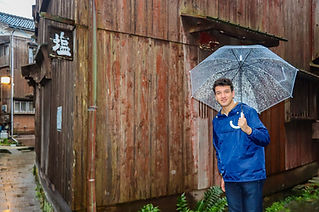
During the Edo period, Yamamoto visited Ogimachi, which was a shipping port for gold and silver, and first visited Kizaki Shrine. Kizaki Shrine was built in 1609 (Keicho 14) by Okubo Nagayasu, the magistrate of Sado, and was also used as a storage place for gold and silver before it was transported by ship to Izumozaki, making it a place of great significance.
Hiroaki Ito of the Sado City World Heritage Division explained the changes that have taken place in Ogi Town, saying, "In the early Edo period, Ogi Town was a poor village that was actively used as a port for transporting gold and silver. However, as the amount of gold and silver decreased, it flourished as a port of call for the Kitamae ships."
Last August, Yamamoto strolled through the fan-shaped townscape, which was designated as an Important Preservation District for Groups of Traditional Buildings by the national government. In front of a house with a protruding second floor, he was told that "the second floor was used for banquets and other events to entertain sailors." The merchants of Ogi Town also acted as patrons, investing in the mine when business was struggling. This is a place that strongly conveys the idea that Sado is one community.
Next, they visited Shukunegi. The town thrived thanks to its shipping and shipbuilding industries, and was designated a Important Traditional Building in 1991. Yamamoto was immersed in the romance of history as he listened to Ito's guide, who explained that "waste materials from ships were reused as building materials for the houses," and "because the land is small, they made sure that the windows did not overlap."


[Looking back on Day 2]
In addition to visiting Gunkanjima (Hashima) in Nagasaki Prefecture, he has also appeared on a TV program that featured Las Médulas, a historic gold mine site in Spain. The Aikawa Gold and Silver Mine he visited on the first day was relatively similar, and it was a mine site that gave him a sense of familiarity.
However, the Tsurushi Silver Mine and the Nishimikawa Gold Mine, where the "O-Nagashi" ceremony took place, are unique to Sado and it was great to be able to see them up close. In particular, the "O-Nagashi" ceremony, which involves systematically changing the flow of water, is an advanced technique not seen at places like the Iwami Silver Mine (Shimane Prefecture). It was a place that really showed the value of being recognized as a World Heritage Site.
Kirarium Sado also has a video of the O-Nagashi process. It is written in a way that tourists can understand. When you actually visit, it can be difficult to imagine the work being done because of the trees, but the video overcomes this difficulty.
Meanwhile, the Tsurushi Silver Mine already had an ecosystem in place, including cupellation techniques and katsuba (finishing fields). One of the reasons for the development of Sado was the creation of an efficient ecosystem and its subsequent transplantation to other mines, such as the Aikawa Gold and Silver Mine.
Additionally, Ogimachi and Shukunegi were important locations for transporting mined gold and silver from the port. Stories such as "banquets were held to revitalize sailors" may represent another social aspect brought about by the gold and silver mines.

Sado's culture nurtured by Mumyoi ware, Noh, and gold mines
On the final day of his visit to Sado, Yamamoto experienced making Mumyoi ware, which has a deep connection to the Sado Gold and Silver Mine. He also visited Daizen Shrine (Mano district), which is home to the island's oldest Noh stage, and Toki no Mori Park (Niibo district).
Mumyoi ware, a traditional Sado pottery, is made using Mumyoi clay from the Sado Gold and Silver Mine, which contains a lot of iron oxide, and gold refining technology is said to have played a major role in the high-temperature firing process.
Yamamoto visited Gyokudo Pottery in the Sawada district. After learning from Hosono Midori of the kiln about the characteristics of Mumyoi ware, such as how it shrinks by about 30% when fired and how it becomes more lustrous the more it is used, he tried his hand at making a cup.
Although he struggled with turning the potter's wheel, which he was not used to, he received advice from the staff and gradually took the shape of a cup. When the cup was finished in about 15 minutes, he looked very satisfied. It takes about two months for the piece to be fired. He is looking forward to receiving the "finished product."
Afterwards, Yamamoto went to Daizen Shrine. Ishikawa introduced the shrine, saying, "The panel at the front of the stage, depicting pine trees and the sun, is rare." Sado Noh became popular on the island when Okubo Nagayasu, the Iwami Magistrate (Sado Magistrate), who oversaw the Iwami Silver Mine area, brought Noh performers with him, and this shrine also has a connection to the Sado Gold and Silver Mine.
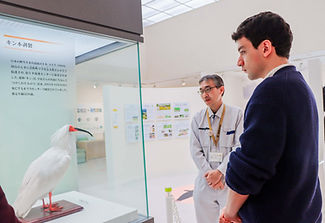
The tour concluded at Toki Forest Park, where Tomoki Tsuchiya of Sado City's Agriculture Policy Division explained the history of crested ibis conservation and the steps taken to reintroduce them into the wild. Tsuchiya explained the surprising connection between gold mines and crested ibises, saying, "When the Aikawa Gold and Silver Mine opened and the population increased, rice fields were developed in the mountains to secure food. Sado's crested ibises survived because there was food in the rice fields in the mountains, where the use of pesticides and chemical fertilizers was limited."



[Looking back on Day 3]
Crustal movements caused gold to accumulate on Sado, and prospectors came to mine it. This could be seen as a "chain of cause and effect" brought about by gold. It was fascinating to learn about the culture and lifestyle that developed around the gold mines, such as Mumyoi ware, which uses clay from the gold and silver mines. I was also surprised to learn that the Japanese crested ibis is connected to the mines through the reclaimed rice fields and the "e" (waterways) that were built next to them using techniques developed in the mines.
With other World Heritage sites, plans tend to focus on visiting only the famous sites. However, Sado has many different aspects. I think that shedding light on aspects other than the gold mine itself will help to highlight the good points of Sado and the significance of tourism.
Throughout the three days, I was drawn to the phrase, "Sado is a microcosm of Japan." With common national issues such as a declining birthrate, aging population, and generational change, I believe Sado's efforts can serve as a model and serve as a reference for thinking about the future of Japan's tourism industry.


©2025 Golden Road Office